
How to support #MedSafetyWeek
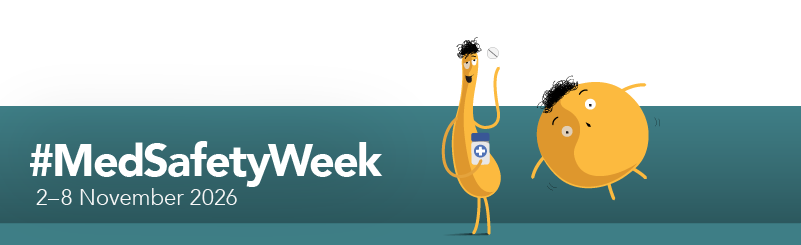
#MedSafetyWeek is a global campaign that encourages people to report suspected side effects of medicines.
We are grateful to everyone who supports the campaign each year. On this page, you'll find information about #MedSafetyWeek and learn how you or your organisation can get involved and help share this important public health message.
Download #MedSafetyWeek resources
If you're ready to use our posters, email signatures, Teams backgrounds and other campaign materials, visit the #MedSafetyWeek resources page. To learn more about the campaign and how you or your organisation can support it, see the FAQs below.
Learn about #MedSafetyWeek
What is #MedSafetyWeek?
#MedSafetyWeek is a global campaign that encourages people to report suspected side effects of medicines. Medicines regulators and healthcare organisations in more than 100 countries take part each year. In Ireland, the HPRA leads the campaign.
During the week, we share campaign messages through social media and a national press release to raise awareness of how, when and why to report suspected side effects. Each year, we also invite organisations across Ireland to support the campaign by sharing its messages with their audiences.
Who organises #MedSafetyWeek?
#MedSafetyWeek is coordinated by the Uppsala Monitoring Centre, which operates the World Health Organization Programme for International Drug Monitoring. Medicines regulators and healthcare organisations in more than 100 countries take part each year. In Ireland, the HPRA leads the campaign.
When will it take place?
It takes place for one week in November every year. In 2026, #MedSafetyWeek will take place from Monday 2 November to Sunday 8 November.
Why is #MedSafetyWeek important?
#MedSafetyWeek helps more people understand why reporting side effects matters and how they can report them.
Reporting side effects helps make medicines safer for everyone. It helps us learn more about a medicine. Each report adds to a bigger picture, helping us spot trends and identify potential safety issues sooner. Every report can make a difference.
What are the main messages of #MedSafetyWeek?
During #MedSafetyWeek, we want everyone to know:
- Anyone can report a side effect, including patients, carers, healthcare professionals and members of the public.
- You can report any side effect, whether it is mild or serious, a known side effect or an unexpected one. Even if you are not sure the medicine caused the side effect, you can still report it.
- You can report directly to the HPRA online, by email, by phone or by post. Visit hpra.ie/report.
- Reporting side effects helps make medicines safer for everyone. Every report can make a difference.
What is the theme for 2026?
The theme of #MedSafetyWeek 2026 is: Don't ignore side effects. Report them.
The 2026 campaign will encourage everyone to stay alert for possible side effects and to remember that side effects can take many forms, from mild to serious. Some may develop immediately and some may develop over time. The campaign will encourage people to consider whether symptoms they are experiencing may be a side effect of a medicine and to report suspected side effects promptly.
Every report helps build a better understanding of the safety of medicines and can help protect others from harm.
Learn about taking part in #MedSafetyWeek
Who can support #MedSafetyWeek?
Anyone interested in medicine safety can support #MedSafetyWeek. This includes:
- Patients and patient organisations
- Healthcare professionals
- Hospitals and GP surgeries
- Pharmacies
- Members of the public
Why do we invite organisations to support #MedSafetyWeek?
Your support can help us reach more people.
By sharing #MedSafetyWeek messages, you can help more people recognise suspected side effects, understand why reporting matters and know how to report. You can help us reach people we may not be able to reach on our own. For example, patient organisations can reach patients and carers directly. Hospitals, pharmacies and other healthcare settings can reach both patients and healthcare professionals.
The more organisations that support the campaign, the more people we can reach with this important public health message. Together, we can help more people understand the importance of reporting side effects.
What posters or other materials can I use to promote #MedSafetyWeek?
Our #MedSafetyWeek resources page contains a range of materials to help you support the campaign and share its messages with your audiences.
Remember that simply sharing the HPRA’s social media posts during #MedSafetyWeek is a valuable way to support the campaign. If you would like to further support this important public health message, you can use our resources to do the following:
- Display #MedSafetyWeek posters in hospitals, pharmacies, GP practices and other relevant settings. Posters are available in a range of sizes.
- Use the #MedSafetyWeek Teams or Zoom background during online meetings.
- Add the #MedSafetyWeek email signature to your emails.
- Share our ready-made #MedSafetyWeek animations and graphics on your social media channels. Contact us if you would like copies, and remember to use the #MedSafetyWeek hashtag.
- Share information about the campaign and how to report suspected side effects through your website, newsletters and other communication channels. You may wish to link to hpra.ie/report or publish our guide to reporting side effects on your website.
Please only use the official #MedSafetyWeek campaign materials in public communications during the campaign week itself (2-8 November 2026). You can share the materials with your contacts beforehand to help them prepare. Before 2 November, feel free to let your audiences know that #MedSafetyWeek is coming and encourage them to support.
When I can start sharing #MedSafetyWeek materials?
Please only share the official #MedSafetyWeek campaign materials on public communications channels during the campaign week itself (2-8 November).
Before 2 November, you can help build awareness by letting your colleagues, members, networks and other relevant audiences know that #MedSafetyWeek is coming. Share posters and resources early so people have time to download and print them, plan their activities, and get ready to like and share #MedSafetyWeek content during the week.
What will the #MedSafetyWeek social media materials look like? Can I see examples?
National regulators and organisations around the world share the same campaign images and videos during #MedSafetyWeek. These materials feature a family of animated characters created especially for the campaign. They help bring the campaign to life and make its messages more engaging and memorable on busy social media feeds.
You can see last year’s animations on our YouTube channel: Animations from #MedSafetyWeek 2025.
This year, the HPRA and other regulators around the world will share similar animations on social media, focusing on the 2026 theme: Don't ignore side effects. Report them.
You can also see the materials already available in the "What posters or other materials can I use to support #MedSafetyWeek?" section.
I want to like and share HPRA social media posts or content from #MedSafetyWeek. Where can I find your posts?
You can find #MedSafetyWeek posts and updates on the HPRA's channels:
To make sure you see content during the campaign, make sure to follow our accounts before #MedSafetyWeek begins on 2 November 2026.
We will also publish a press release on hpra.ie/news. To receive the press release by email, sign up to our My Alerts email notification service and choose the "press release" category.
Who can I contact for more information?
Contact communications@hpra.ie for more information about taking part in #MedSafetyWeek.
If you have questions about reporting side effects, see:
- For patients and carers: Reporting a suspected side effect as a patient or carer
- For healthcare professionals: Reporting a suspected side effect as a healthcare professional